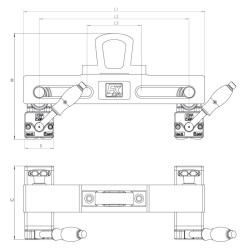
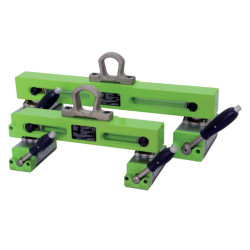
Magnetic traverse holder FX-KT 480-600
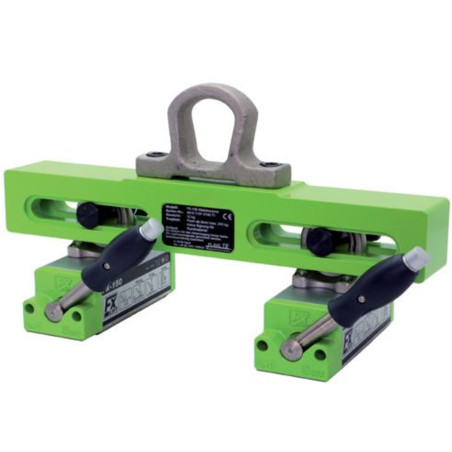
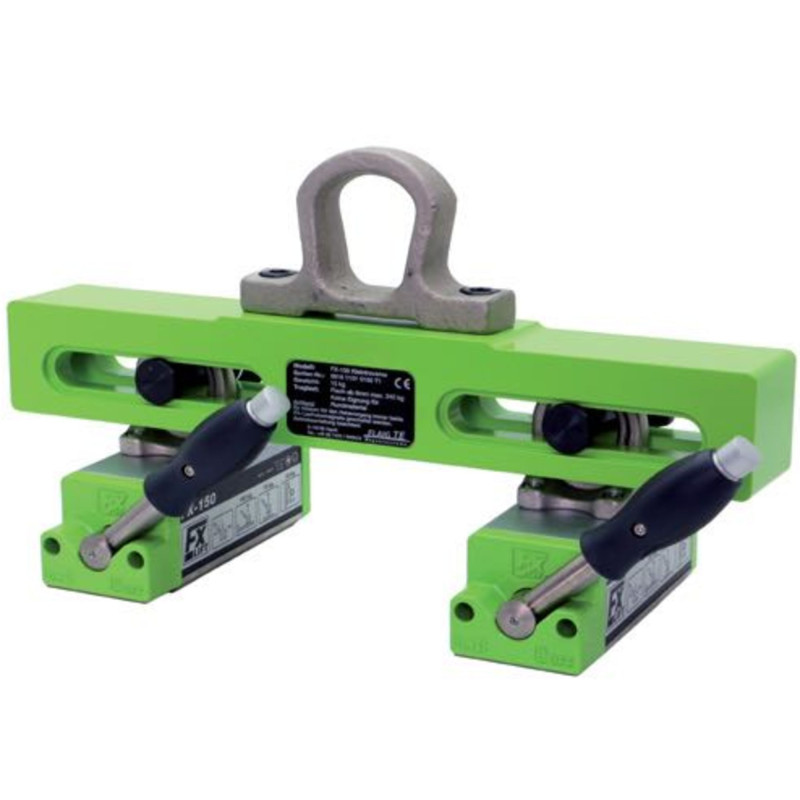
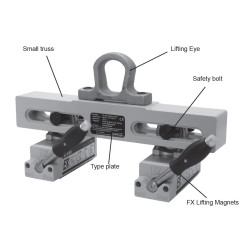
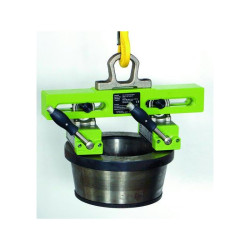
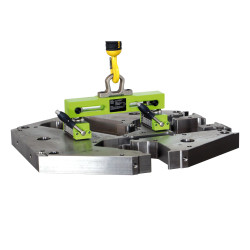
The FX-KT 480-600 magnetic traverse holder, which uses two FX-300 lifting magnets, lets you lift and transport almost anything. This is especially useful for items with a central hole, where using a single lifting magnet can be dangerous because the centre of gravity is shifted. The FX-KT holder is also great for transporting longer items. Using two FX series lifting magnets and adjustable spacing stops the items from bending during transportation. Also, using two lifting magnets with a lower total lifting capacity than one is better for thin items, because the thickness of the item affects the actual lifting capacity. The lifting magnets can be put together and taken apart easily, so they can also be used on their own, for example to handle smaller parts. The steel crossbeam is completely covered in powder coating.
Do not use the systems to lift loads heavier than the nominal lifting capacity of the lifting magnets.
Magnetic lifting magnets (lifts) are magnetic circuits made using permanent magnets. They are used to lift and move heavy iron and magnetic steel elements. These devices do not require any external or internal power supply. The magnetic field is switched on and off by moving a manual lever. The magnetic field of the lifting magnets is generated by the latest generation of sintered neodymium magnets. Despite their small size and relatively low weight, they are very convenient and easy to use. They are used in steel yards, factories, warehouses, workshops, docks and wherever they can be helpful in moving sheets, plates, profiles, bars and other large iron elements.
The actual lifting capacity of the FX-HV depends on the following factors:
Elements that are too thin may be attracted weakly because the magnetic field of the lifting magnet is not fully utilised. Very thin sheet metal is saturated by only a small part of the magnetic field, and the remaining part of the magnetic field penetrates beyond the sheet metal into the environment, unused. In this case, the magnetic circuit of the lifting magnet is not optimally closed. In addition, thin elements bend and their contact surface with the magnet becomes linear, which rapidly reduces the lifting force. The best lifting performance is achieved with sufficiently thick elements that correctly close the magnetic circuit, utilising the entire magnetic field of the magnet.
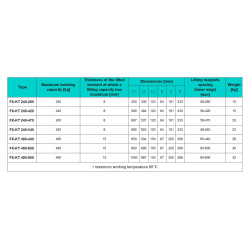
The table below shows the optimum steel thickness (for which the lifting capacity is 100%).
| Thickness of the lifted element at which the FX-KT 480-600 has a lifting capacity of 100% | 15 mm |
(the higher the iron content, the greater the lifting capacity: the lifting capacity coefficient for low-carbon steels is 1.00; for high-carbon steels - 0.90; for low-alloy steels - 0.75; for cast iron 0.50).
Various ferromagnetic materials interact with magnets in different ways (they have different magnetic properties). Some are attracted more strongly, while others are attracted less strongly. This depends on the structure and chemical composition of the material. For example, pure iron (Armco) is attracted more strongly than carbon steels, and carbon steels are attracted more strongly than cast iron.
| Type | Nominal hoisting capacity [kg] | Load capacity permissible for the material * [kg] | |||
| Low carbon steel 100% | High carbon steel 90% | Low-alloy steel 75% |
Cast iron 50% |
||
| FX-KT 480-600 | 480 | 480 | 430 | 360 | 240 |
*) it will be the permissible load capacity for an element made of a given material, if it is not reduced by other factors (thickness, surface quality, shape).
Ambient temperature and temperature of the lifted element (must not exceed 80°C).
In lifting magnets, sintered neodymium magnets are the source of the magnetic field. For neodymium magnets, the temperature coefficient for remanence induction Br is approximately -0.12 %/o[C] and the temperature coefficient for coercivity is -0.6 %/o[C]. Negative temperature coefficients mean that at temperatures above room temperature, neodymium magnets are slightly ‘weaker’.
Magnetic lifters are not a source of noise.
Delivery time: 8–10 working days